NMQ Style Musculoskeletal Digital Form
The Nordic Musculoskeletal Questionnaire (NMQ) is one of the most widely used questionnaires for identifying self-reported musculoskeletal symptoms across different body regions.
Rather than measuring pain intensity, the NMQ identifies where symptoms occur, whether they have interfered with normal work or daily activities, and whether respondents have sought medical attention for those symptoms.
This digital implementation follows the structure of the Nordic Musculoskeletal Questionnaire while simplifying data collection for ergonomics research, workplace assessments, occupational health studies, and academic research.
How to Use the Digital NMQ
This digital implementation is designed for quick and simple data collection. Results are exported in CSV format.
In practice, researchers typically open this website on a mobile phone, tablet, or laptop, and then hand the device directly to the respondent to complete the questionnaire.
This approach eliminates the need for paper forms, speeds up data recording, and reduces the risk of errors during manual data entry.
Respondents first select all body parts that have experienced musculoskeletal symptoms during the specified time period. Follow-up questions are then shown only for the selected body parts, reducing unnecessary questions while preserving the information collected by the questionnaire.
Since the assessment is often conducted using a device provided by the researcher, it is recommended that the researcher remain nearby to explain the procedure without influencing the respondent's answers.
Digital NMQ Flow Implementation Notes
Traditional NMQ forms typically ask respondents the same series of questions for each body part, regardless of whether symptoms are reported.
In this implementation, respondents first select the body parts that experienced symptoms. Follow-up questions are then presented only for the selected body parts, reducing the number of questions that need to be answered while preserving the questionnaire responses.
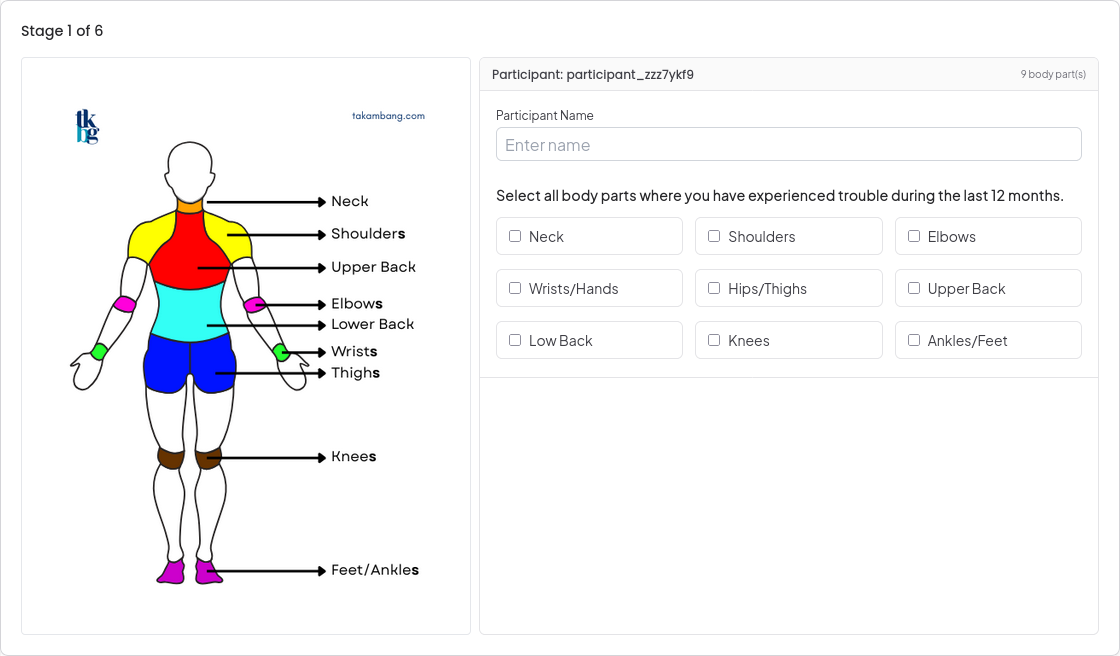
This interaction attempts reduces the number of questions that need to be answered while maintaining the logical flow of the questionnaire.
Respondents may spend less time completing the assessment, particularly when symptoms are limited to only a few body regions.
The exported dataset preserves the questionnaire responses in CSV format, making it suitable for statistical analysis while providing a digital alternative for data collection for both researchers and respondents.
Digital NMQ Visualization Notes
After completing the questionnaire, the responses are summarized into a visual body map and a set of body-part summary cards.
This provides a convenient overview of the reported symptoms without requiring researchers to review each questionnaire item individually.
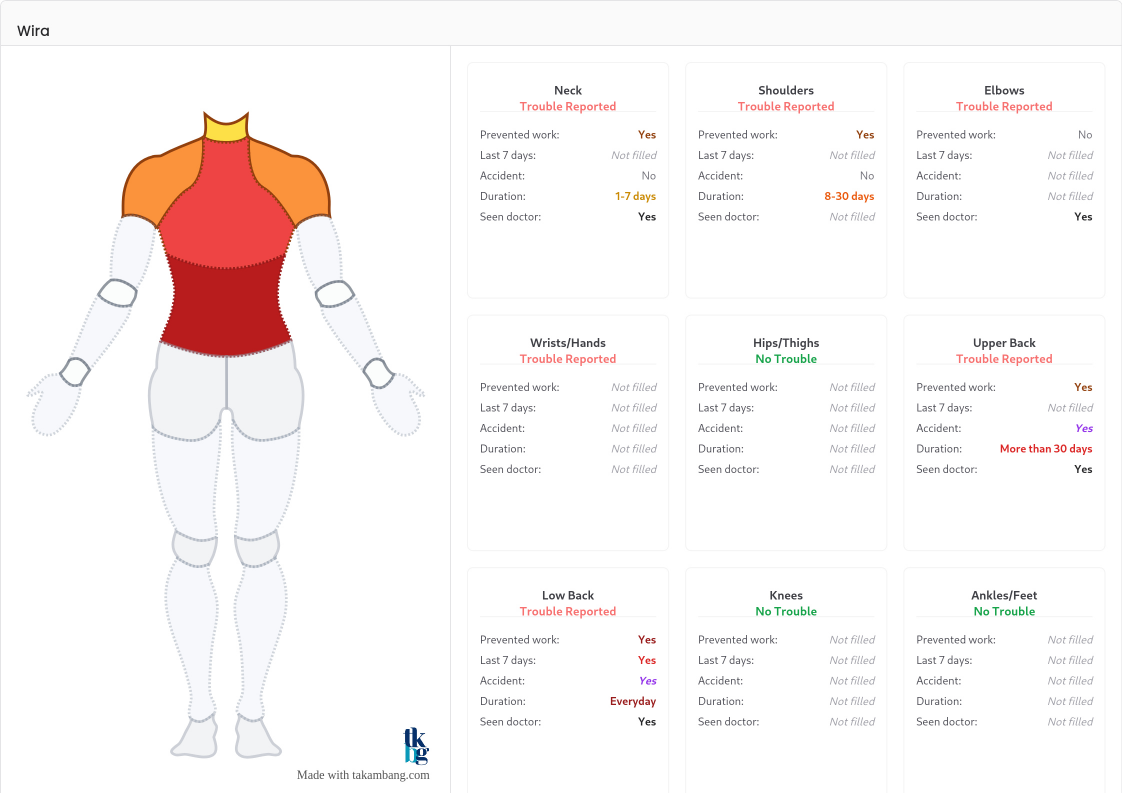
- Light gray fill indicates no musculoskeletal symptoms were reported during the previous 12 months.
- Yellow fill represents symptoms lasting 1–7 days.
- Orange fill represents symptoms lasting 8–30 days.
- Red fill represents symptoms lasting more than 30 days.
- Dark red fill represents symptoms experienced every day.
- Orange border indicates the symptoms prevented normal work during the previous 12 months.
- Dark red border indicates the symptoms both prevented normal work and were still reported during the previous 7 days.
- Dashed border indicates the symptoms were reported as accident-related.
Each summary card presents the questionnaire responses for the selected body region, including work limitation, recent symptoms, accident history, symptom duration, and whether medical attention was sought.
Together, the body map and summary cards provide a visual overview of the reported responses while preserving the complete NMQ response for analysis and reporting.
Although this visualization preserves the original questionnaire responses, any modification to the questionnaire format or presentation should be evaluated before use in research. Researchers are encouraged to perform appropriate validity and reliability testing to ensure that the digital implementation produces measurements comparable to the validated NMQ instrument.