NASA-TLX Digital Form
The NASA Task Load Index (NASA-TLX) form is used to measure the subjective workload experienced by a person after completing an activity or task.
NASA-TLX evaluates six workload dimensions, namely Mental Demand, Physical Demand, Temporal Demand, Performance, Effort, and Frustration Level.
This method is widely used in research, ergonomics, system development, and user experience evaluation to understand the level of workload experienced by respondents.
How to Use the Digital NASA-TLX
This digital implementation is designed for quick and simple data collection. Results are exported in CSV format:
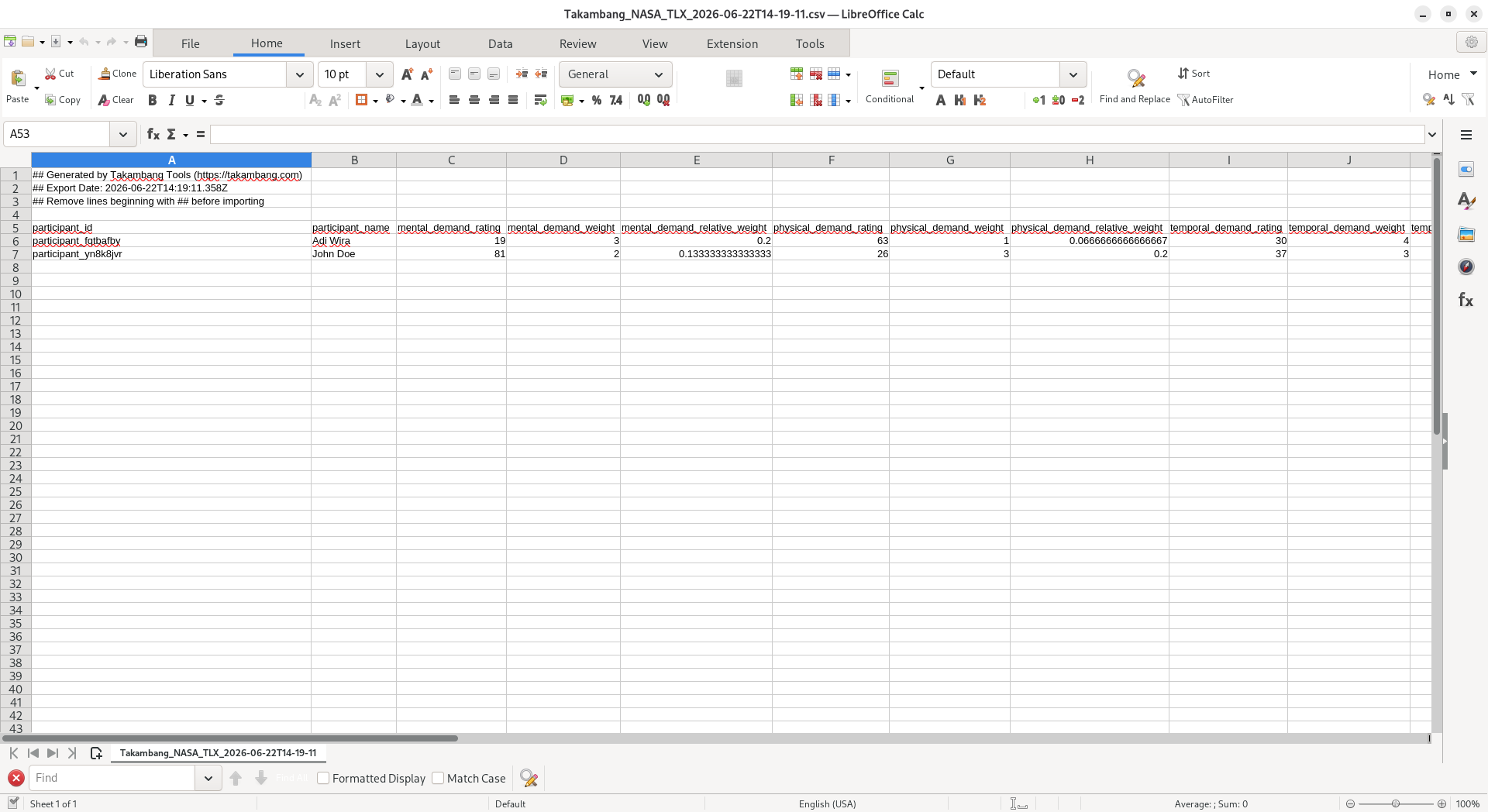
In practice, researchers typically open this website on a mobile phone, tablet, or laptop, and then hand the device directly to the respondent to fill out after the activity is completed.
This approach eliminates the need for paper forms, speeds up data recording, and reduces the risk of errors during manual data entry.
To use this form, ask the respondent to rate each dimension based on the experience they felt during the evaluated activity. There are no right or wrong answers.
Since the assessment is often conducted using a device provided by the researcher, it is recommended that the researcher remain nearby to provide guidance on the procedure without influencing the respondent's answers.
Respondents simply move the slider for each dimension until it reflects the level of perceived workload, then submit the assessment after all questions are completed.
Digital NASA-TLX Implementation Notes
Unlike many digital NASA-TLX forms that use Likert scales (e.g., 1–5 or 1–7), this implementation uses continuous sliders to collect ratings for each workload dimension.
This approach aligns with the NASA-TLX software implementation introduced by Cao et al. (2009), where workload ratings are made on a continuous range of values rather than using a limited number of discrete categories.
Using sliders provides greater flexibility in the rating process. Respondents can place the value at the position they consider most representative of their workload perception without having to force their choice into a specific category.
This approach helps reduce the tendency for pigeonholing often found in fixed category scales, while also producing more granular data for analysis, visualization, and advanced data processing needs.
However, the use of sliders is not intended to increase the absolute subjective precision of respondents. The main goal is to provide greater freedom in expressing workload perception so that the given values can reflect the felt conditions more naturally.