Activity & Space Relationship Generator
This tool generates two essential spatial planning diagrams: the Activity Relationship Chart (ARC) and the Simulated Space Relationship Diagram (SRD).
The ARC defines qualitative relationship priorities between activities (such as Absolutely Necessary, Important, or Undesirable), while the simulated SRD translates those priorities into a spatial layout simulation, helping visualize proximity, clustering, and separation between spaces.
How to Use the Activity & Space Relationship Generator
This tool generates two commonly used spatial planning artifacts in facility layout design: the Activity Relationship Chart (ARC) and a simulated Space Relationship Diagram (SRD).
The following video demonstrates how to create an Activity Relationship Chart and generate a Space Relationship Diagram using this tool.
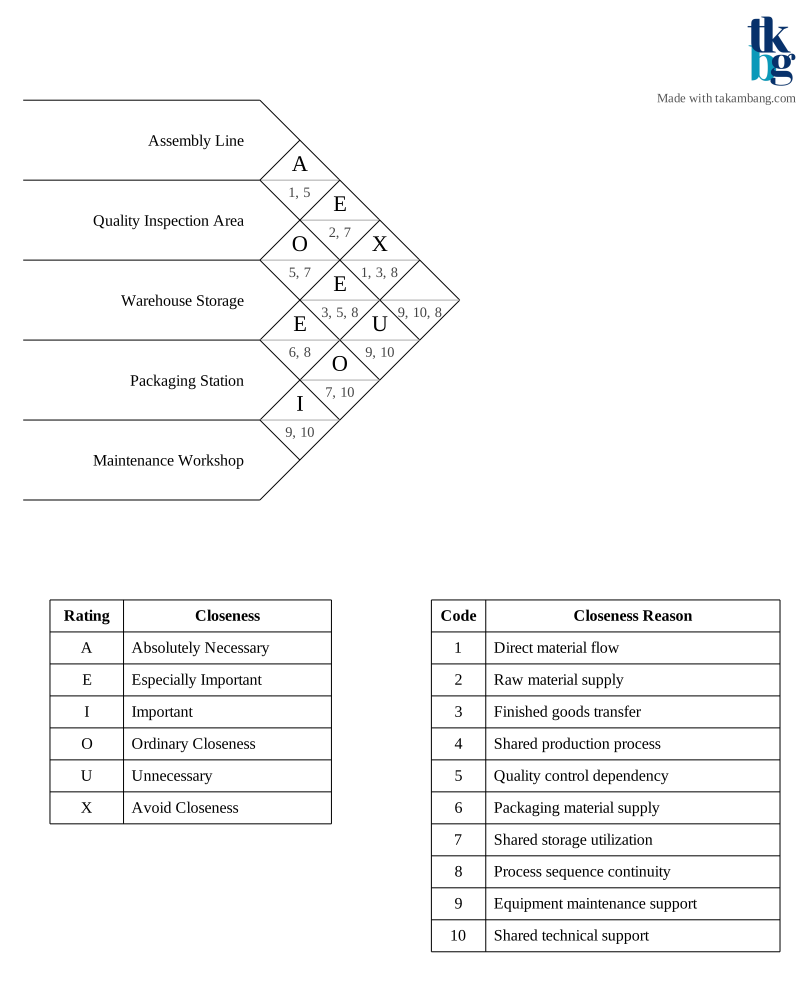
The Activity Relationship Chart (ARC) represents the qualitative closeness requirements between activities, departments, or functional spaces.
Conceptually, the ARC can be viewed as a structured form of an affinity diagram, where relationships are seeded using predefined proximity priorities. These priorities make the relationship matrix easier to interpret and help guide subsequent spatial layout decisions.
In facility layout planning, these relationships are typically categorized using standardized closeness ratings:
- A — Absolutely Necessary
- E — Especially Important
- I — Important
- O — Ordinary
- U — Unimportant
- X — Undesirable
In addition to the closeness rating, ARC matrices often include reason indices that explain why two activities should be located near or far from each other. These indices typically reference operational considerations such as material flow, shared resources, communication requirements, safety constraints, or environmental factors.
Using numerical or coded reasons allows the chart to remain compact while preserving important design rationale, helping planners understand the justification for each relationship and make adjustments when layout constraints change.
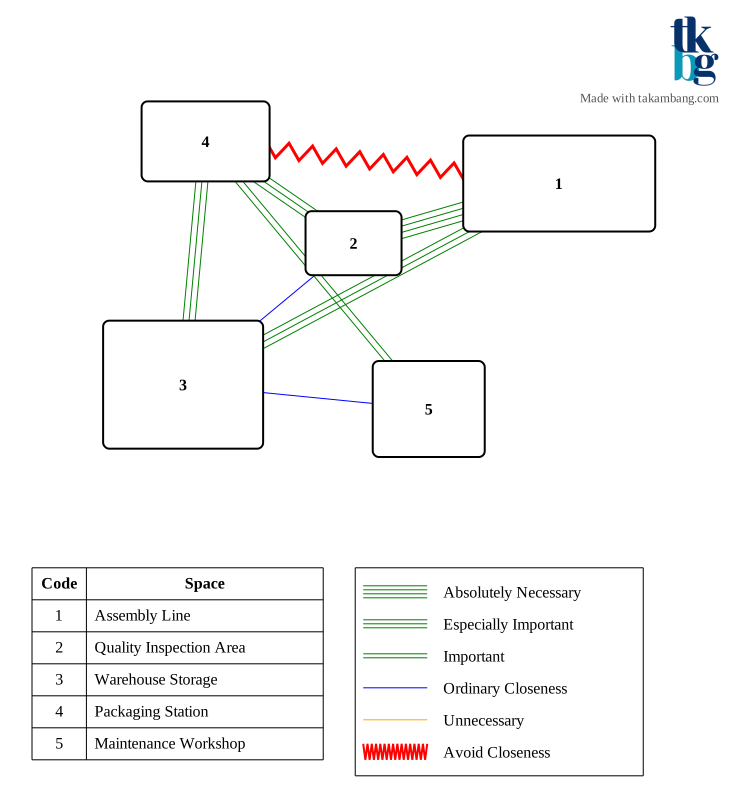
Once the ARC matrix has been defined, these qualitative relationships can be translated into a Space Relationship Diagram (SRD). The SRD provides a visual representation of how activities should be positioned relative to one another, highlighting clusters of closely related activities while separating incompatible ones.
In this generator, the SRD is produced using a force-based layout simulation. Each activity is modeled as a node within a system of simulated forces derived from the ARC relationships, and is associated with a spatial dimension. This allows the simulation to approximate real layout constraints while preventing overlapping placements between activities.
Positive relationships (such as A, E, and I) introduce attractive forces that pull activities closer together, while weaker or undesirable relationships (such as U and X) introduce repulsive forces that push activities apart. The system iteratively adjusts node positions until a relatively stable spatial configuration emerges.
Because this method relies on iterative simulation, the resulting diagram should be interpreted as a heuristic approximation rather than a globally optimal facility layout. Nevertheless, it provides a useful visual guide for identifying clusters of strongly related activities and potential separation constraints during the early stages of layout planning.
The generated diagrams emphasize structural relationships rather than presentation styling. Users may export the results and further customize the visual representation — for example by applying alternative color schemes, annotations, or diagram styles — using external diagram editors or presentation tools.
Activity Relationship Chart and Space Relationship Diagram Examples
The following examples illustrate a typical Activity Relationship Chart (ARC) and the resulting Space Relationship Diagram (SRD) generated using the tool.
Activity Relationship Chart (ARC)
Space Relationship Diagram (SRD)